
Skip to content
Aviation Discourse
Facebook
  • Login | Register
  • Seminar
  • Exposition
  • Historical facts
  • Quiz
  • About
  • Contact
Aviation Discourse
  • Seminar
  • Exposition
  • Historical facts
  • Quiz
  • About
  • Contact
Log In | Register

Seminar Presentation

  • AIRPORT PASSENGERS SERVICES: AIRPORT TRANSPORTATION (TAXI SERVICES)
  • AIRPORT HAZARDS AND CONTROL: SAFETY PARAMETERS
  • AIRPORT PASSENGER SERVICES: RIGHTS AND RESPONSIBILITIES
  • THE ROLE OF GOVERNMENT AGENCIES IN THE NIGERIAN AVIATION INDUSTRY
  • AIRPORT WASTE MANAGEMENT SYSTEMS AND SERVICES
  • AVIATION SECURITY – ADDRESSING THE INSIDER THREAT
  • FOREIGN OBJECT DEBRIS (FOD) PREVENTION
  • AIRSIDE DRIVING AND VEHICLE CONTROL

Aviation Terminologies and Exposition

  • AIRCRAFT TURNAROUND TIME
  • AERONAUTICAL BEACON
  • AERODROME TRAFFIC ZONE (ATZ)
  • AERODROME TRAFFIC DENSITY
  • MAYDAY
  • ACCIDENT vs INCIDENT
  • APRON vs RAMP vs TARMAC
  • AERODROME vs AIRPORT

Aviation Historical Facts

  • First Use of Radio Onboard a Plane
  • Establishment of ICAO
  • David Warren Invented the First Flight Recorder
  • First Airport Lounge
  • Deadliest Accident in Aviation History
  • World’s First Air Traffic Controller
  • First Fully Operational Boarding Bridge
  • First Adoption of Standards and Recommended Practices
  • First Radio-Equipped Air Traffic Control Tower
  • First World’s Female Flight Attendant

Deadliest Accident in Aviation History

By Utibe Inyang

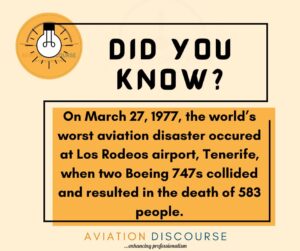
On March 27, 1977, two Boeing 747 passenger jets collided on the runway at Los Rodeos Airport (now Tenerife North Airport) on the Spanish island of Tenerife.

The collision occurred when KLM Flight 4805 initiated its takeoff run while Pan American Flight 1736 was still on the runway. The impact and resulting fire killed everyone on board KLM 4805 and most of the occupants of Pan American 1736, with only 61 survivors in the front section of the aircraft.

Investigation revealed that there was communication misinterpretation and false assumptions.

As a consequence of the accident, sweeping changes were made to aircraft, international airline regulations, and cockpit procedures. Aviation authorities around the world introduced requirements for standard phrases and a greater emphasis on English as a common working language.

With 583 fatalities, the disaster is the deadliest accident in aviation history.

Share This Article :
  • Facebook
  • Twitter
  • LinkedIn
  • Pinterest
0 0 votes
Rate this Article
Subscribe
Notify of
guest
guest
0 Comments
Inline Feedbacks
View all comments
Featured Brands
New Project (12)
New Project (13)
nuate-ad
New Project (14)
New Project (15)
New Project (16)
New Project (17)

About Aviation Discourse

About
Contact Us

Resource Person

If you wish to become a resource person or contribute an article in Aviation Discourse, click the link to contact us.

Copyright © 2026 Aviation Discourse. All rights reserved.

Terms of use | Privacy Policy | Disclaimer  |  Powered by Courselord

  • Login
Forgot Password?
Lost your password? Please enter your username or email address. You will receive a link to create a new password via email.
We use cookies to ensure that we give you the best experience on our website. If you continue to use this site we will assume that you are happy with it.Ok, I Agree